Disclaimer: This article represents my personal views as a Canadian. It is not connected to, endorsed by, or reflective of my employer or my professional responsibilities.
Canada stands at a crossroads. While we have historically led the world in AI research, we are at risk of becoming a “branch plant” economy if we do not urgently address the gaps in compute infrastructure and capital sovereignty.
The next phase of our national development requires us to stop being merely an exporter of raw talent and electricity, and instead become the world’s “Refinery for AI”. This article is intended to be a citizen-led policy narrative outlining a strategy to position Canada as the world’s destination for clean, reliable, sovereign AI compute, anchored by our energy advantage, research ecosystem, and commitment to responsible governance.
Why is Canada well positioned for Energy-AI integration?
Canada can pursue “AI leadership” and “energy superpower” ambition as a single integrated national project because the enabling assets already exist in identifiable, institutional form.
AI Institutional Footprint
Canada was the first country to release a national AI strategy in 2017, and characterizes the Pan-Canadian Artificial Intelligence Strategy as a $125 million initiative delivered by CIFAR (Canadian Institute For Advanced Research). Canada also has more than 650 AI startups and more than 24 generative AI companies, ranks fourth globally in generative AI companies per capita, and is third among G7 countries in total funding per capita raised for generative AI companies. That institutional footprint matters because it is durable and it creates an ongoing pipeline for research, talent attraction, and collaboration that can be scaled.
Energy Potential
Canada’s energy profile makes a credible compute strategy possible. Natural Resources Canada documents a substantial and growing primary energy base. Canada’s primary energy production in 2021 was **35% above 2005 levels (outpacing global growth), and we rank #2 hydroelectricity production and #2 uranium production **globally. This matters for data-centers and compute clusters because investors increasingly care about long-term power availability, and price stability. However, the Energy Fact Book 2024 also shows that Canada’s total energy supply in 2021 remained largely fossil-based (76%) and that renewables only accounted for 16.6%. Hence clean compute at scale is best achieved by expanding low-carbon electricity supply and grid capacity, not just by reallocating existing clean power.
It is evident that out national strategy on both these areas should be mutually beneficial and has combined outcomes. The three pillars to making this strategy a reality are
- Build Sustainable AI Computing Infrastructure with Energy Advantage
- Drive Public & Defence Sector Adoption, Security, and Trust
- Fuel Homegrown AI Innovation and Scale-Up
1. Build Sustainable AI Computing Infrastructure with Energy Advantage
Canada’s path to becoming an energy superpower is the key to its AI sovereignty. Data-centers are increasingly energy-intensive, and Canada’s cold climate and low-carbon grid provide a natural competitive advantage.
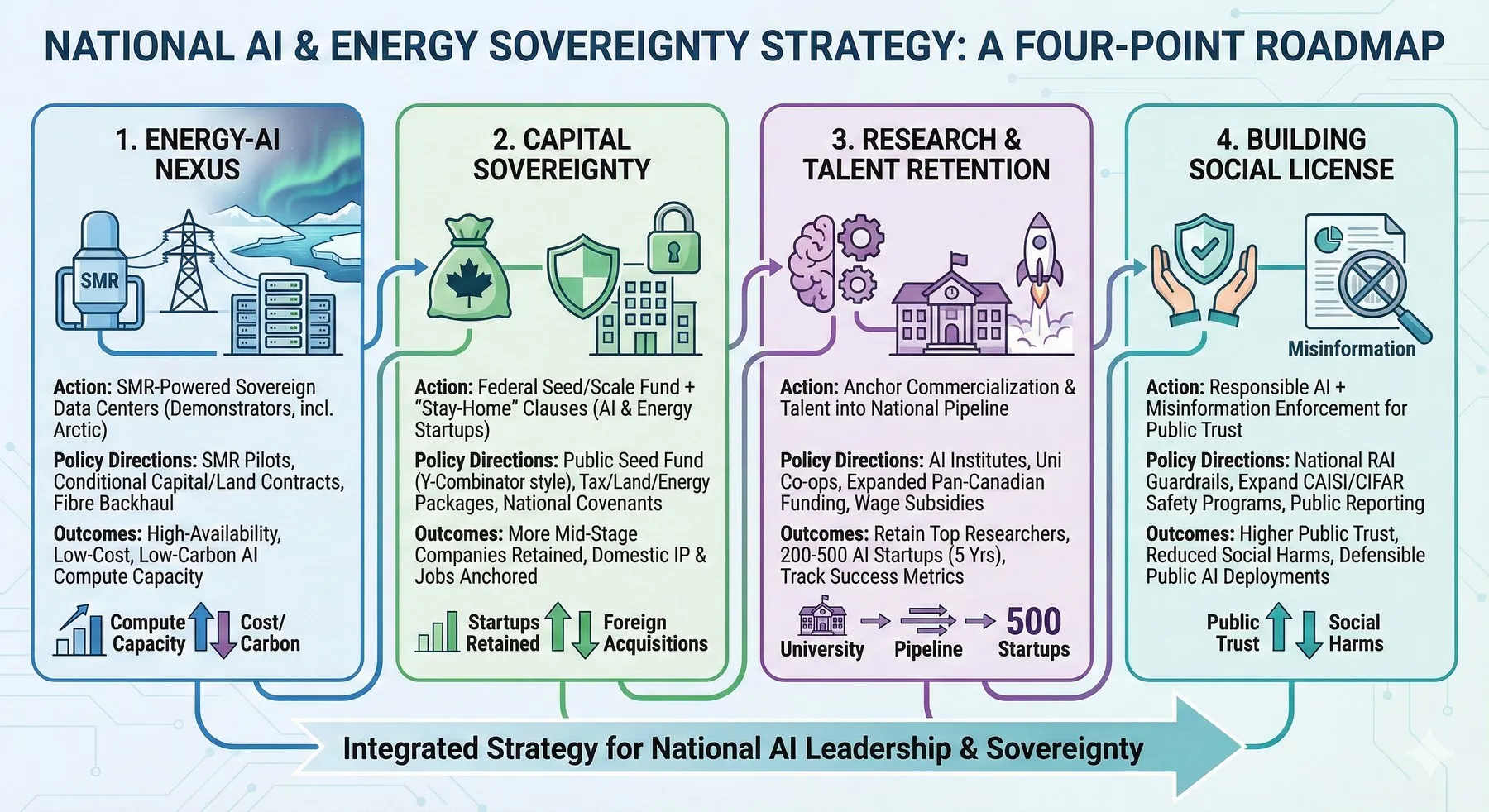
- Nuclear Energy Leadership: We must accelerate the **Small Modular Reactor **(SMR) Roadmap while simultaneously innovate on** fusion based micro-reactor** tech for long term success. SMRs represent the ideal baseline power source for large-scale AI data-centers, providing the stable, non-emitting energy required for 24/7 operations.
- Net-Zero Synergy: Integrating AI infrastructure with our Net-Zero 2050 goals allows us to mandate that data-center operators invest in clean technology, turning the “energy problem” of AI into a “funding solution” for our green transition.
A practical framing is to position Canada as a destination for “clean AI compute”. A place where data-centers and AI tech ecosystems/clusters can be built with responsible governance, reliable electricity, and long-term policy stability. The strategy does not require perfect uniformity across provinces rather, it requires a national-level plan that coordinates incentives, grid readiness, and regulatory clarity so that Canada can compete with jurisdictions that are aggressively courting AI infrastructure.
Role of the Canadian Far-North Regions
Canada’s Far-North represents one of the most under-utilized strategic assets in the global race for clean, sovereign compute. The region’s naturally cold climate dramatically reduces cooling costs for hyper-scale data-centers, while its proximity to vast untapped renewable and nuclear energy potential (including hydro, wind, and SMR deployments) creates the conditions for some of the world’s lowest‑carbon AI compute. To unlock this opportunity, Canada must pair energy development with a major expansion of Arctic and sub‑Arctic fibre‑optic backhaul, ensuring that remote regions are connected to national and international networks with the bandwidth required for AI workloads. This combination of clean power, cooling efficiency, and high‑capacity connectivity would allow Canada to build a distributed, resilient data‑center footprint that strengthens sovereignty, accelerates northern economic development, and positions the country as a global leader in sustainable AI infrastructure.
2. Drive Public Sector Adoption, Security, and Trust
Public trust is not a “nice-to-have” in the AI era, it is a fundamental operational infrastructure. Intentions described in Canada’s proposed **Bill C-27 **and the **Artificial Intelligence and Data Act **(AIDA) signify a pivotal moment and a crucial step in responsible AI regulation, framed around safeguarding privacy, civil liberties, and ethical considerations while enabling innovation. This kind of governance posture can be positioned as a competitive advantage: it gives innovators and investors clearer rules and gives citizens confidence that AI systems are bounded by enforceable expectations.
For AI to be a national success, it must have public trust. This requires a two-pronged approach to public trust building:
- Societal Benefit: Deploying AI to optimize social programs, ensuring that government resources reach citizens with maximum efficiency. Canada has a soul which is deeply rooted in its values. We should be pioneers in the use of AI for public/societal benefit. This would include AI-led/AI-driven solutions for social programs by bringing efficiency and movement of most dollars to the last-mile (actual citizens getting help).
- Protection of Truth: Expanding misinformation and espionage laws to address AI-driven threats. Canada should lead the world in providing a “grounded-truth” service publicly accessible reporting that clarifies facts and identifies sources of foreign or domestic misinformation.
Enabling widespread adoption requires workforce readiness. The same Canadian narrative stresses that ensuring AI benefits everyone requires collaboration across policymakers, academics, civil society, and industry, and that government and industry share responsibility for equipping Canada’s workforce with skills and opportunity in an AI economy.
Defence as a National R&D Engine
Modern defence is increasingly software‑defined, data‑driven, and AI‑enabled. Canada’s investments in defence and national security capabilities can double as a civilian innovation engine. Taking cues from the Apollo lunar programs in the 50s and 60s, a nationally aligned strategy like modernizing our defence and security could provide the much needed vehicle through which ground breaking AI innovations can be experimented and perfected. Grand scale progress requires national-scale bold bets.
Instead of treating defence sector AI as a narrow procurement file, Canada could frame it as:
- A national testbed for frontier AI (perception, planning, autonomy, decision support).
- A guaranteed early customer/adopter for Canadian AI companies.
- A long‑horizon funder of future tech (compute, sensors, robotics, cyber, synthetic data)
Similar to Apollo program, where the mission was the moon, but the real output was a generation of scientists, engineers, and technologies that spilled over everywhere.
3. Fuel Homegrown AI Innovation and Scale-Up
Canada’s ecosystem has enough density to justify a dedicated scale-up strategy. The Canadian AI landscape is described (via a Deloitte report referenced in a Canadian policy narrative) as including 670+ AI startups, with strong per-capita positioning globally and strong per-capita funding positioning within the G7. This suggests two complementary needs: (1) protect the pipeline of new firms through early support and (2) strengthen the domestic path to scale so that value creation (jobs, IP, exports) accumulates in Canada rather than drifting elsewhere.
Government-backed seed fund for Energy-AI innovations
The “brain drain” to the United States is often driven by the “capital drain.” To counter this, Canada needs a *government-backed, high-conviction seed fund program for Energy-AI innovations *(think of this as a Government-led Y-Combinator). This initiative would provide intentional capital to startups working on frontier AI ideas, ensuring they remain domestic as they scale. This aligns with recent expansions in the BC Strategic Innovation Fund (sovereignty through capital) but requires a more agile, accelerator-style approach to capture early-stage innovation before it moves south.
Push the Frontiers of AI Talent and Research
The implication is that Canada’s next phase of AI investment should not be limited to “more research funding” in isolation. The goal should be to build a full-stack talent pipeline -> frontier research capacity, applied pathways into industry and government, and a national capability for safe, scalable AI deployment. While the supporting sources here focus primarily on institutions and ecosystem scale, they also stress an important constraint: AI development requires access to data and compute power as foundational building blocks. Talent strategy therefore cannot be separated from compute strategy; the most advanced researchers increasingly go where compute access is reliable, affordable, and policy-stable.
Let’s ask ourselves a simple question:
How many Canadian programs reliably feed aerospace and astrophysics talent into CSA and defence research roles?
Sadly the answer might be one or two at best. These are areas where a broader funnel needs to be intentionally established in national interest and yet where we lag behind the most. We need public universities to start investing in undergraduate and graduate programs in AI-forward fields like
- Computational Linguistics
- Cognitive Systems (Neural Networks)
- Computational Psychology
- Synthetic Biology & Robotics
In practical terms, this translates into a national agenda that (a) **increases the number of elite research institutes **for fields already described under the Pan-Canadian strategy, (b) builds more applied pathways so that research transitions into real-world systems in health, public safety, and energy, and ensures that Canadian researchers have access to world-class compute without needing to relocate to obtain it. The “how” of that compute expansion is addressed in the above pillar #1; the key takeaway here is that compute scarcity becomes a direct threat to talent retention.
Roadmap, Actions and Outcomes
Risks, trade‑offs, and potential mitigation
- Capital flight / foreign influence: Attracting foreign capital can bring scale but risks loss of IP. Mitigation: conditional incentives, golden‑share clauses for national‑importance firms, and staged funding tied to Canadian retention metrics.
- SMR social & regulatory risk: SMR deployment requires Indigenous consent, regulatory approvals, and public acceptance. Mitigation: early, funded Indigenous engagement; transparent environmental assessments; pilot community benefits agreements.
- Grid & emissions mismatch: Rapid data‑center growth increases electricity demand; if grid decarbonization lags, emissions rise. Mitigation: require low‑carbon energy contracts (SMR/renewables), and align with Net‑Zero plans.
- Public trust & misinformation: AI adoption can be undermined by fear. Mitigation: national UBI/retooling pilots, public‑good AI projects, and transparent misinformation reporting.
Closing Thoughts
Competitive & strategic advantage in the AI era will belong to the countries that treat compute, energy, talent, and governance as a single system rather than separate portfolios. Canada already has a nationally described AI backbone strategy, and has documented energy scale and growth, with measurable global rankings that can be translated into an investable “clean compute” proposition if paired with deliberate electricity and infrastructure planning. While the ingredients to success are present, nostalgia is not a strategy and there is a lot of policy decisions needed to set us up for success as a nation.
With policy momentum such as the 2024 and 2025 budget investments to secure Canada’s AI advantage, the strategic window is open to align AI investment with clean power expansion, public service modernization, and governance that sustains trust. I sincerely hope our government (current and subsequent ones) don’t take the foot off the pedal on these efforts in the coming decade.
🇨🇦
— — — — — — — — — — — — — — — — — — — — —
Sources and references:
- Pan-Canadian Artificial Intelligence Strategy : https://ised-isde.canada.ca/site/ai-strategy/en
- Energy Fact Book 2024 : https://energy-information.canada.ca/sites/default/files/2023-10/energy-factbook-2023-2024.pdf
- Powering Canada’s Future (A Clean Electricity Strategy) : https://natural-resources.canada.ca/sites/admin/files/documents/2025-08/Clean-Electricity-Strategy.pdf
- Canada SMR Action Plan : https://natural-resources.canada.ca/energy-sources/nuclear-energy-uranium/canada-s-small-modular-reactor-action-plan
- Canadian Sovereign AI Compute Strategy : https://ised-isde.canada.ca/site/ised/en/canadian-sovereign-ai-compute-strategy
- Bill C-27 and the Artificial Intelligence and Data Act : https://ised-isde.canada.ca/site/innovation-better-canada/en/artificial-intelligence-and-data-act-aida-companion-document
- Responsible AI : https://www.canada.ca/en/government/system/digital-government/digital-government-innovations/responsible-use-ai.html
- Canada First Research Excellence Fund : https://www.cfref-apogee.gc.ca/home-accueil-eng.aspx
- AI Strategy for the Federal Public Service 2025–2027 : https://www.canada.ca/en/government/system/digital-government/digital-government-innovations/responsible-use-ai/gc-ai-strategy-overview.html
- Arctic Full-Spectrum Communication : https://www.canada.ca/en/department-national-defence/programs/defence-ideas/element/competitive-projects/challenges/full-spectrum-communications-arctic.html
- Canada Net-Zero 2025 : https://www.canada.ca/en/services/environment/weather/climatechange/climate-plan/net-zero-emissions-2050.html